LOWER SCORES, FEWER STUDENTS
College Board reports largest drops in SAT scores since 1970s
as well as a decline in test takers, apparently from low-income
groups....Gaps among racial and ethnic groups continued to be significant on the SAT, including the new writing test, for which the first mean scores were released at the College Board’s annual SAT briefing on Tuesday.
What can librarians do to help? Parents need to be readers to encourage their children to choose that the SAT and other college tests are for them.
Many ideas here:
Library Service to Underserved Populations.Services to Adult New and Non-Readers
This adult literacy page is designed to help you easily access resources, materials, and information related to literacy at ALA, literacy in libraries, and literacy in communities, both real and virtual.
Wednesday, August 30, 2006


Tuesday, August 29, 2006
Hurricanes Relief for Libraries. A Librarian at the Kitchen Table. No. 401
Libraries and Hurricane Katrina
PLEASE DONATE TO THE
ALA HURRICANE KATRINA LIBRARY RELIEF FUND
Please click on the links below to view a list of resources:
HOW TO HELP | ADOPT A LIBRARY PROGRAM | LIBRARY STATUS REPORTS | RELIEF EFFORTS | GRANTS | DISASTER RECOVERY | COPING RESOURCES | OTHER RELIEF
PLEASE DONATE TO THE
ALA HURRICANE KATRINA LIBRARY RELIEF FUND
Please click on the links below to view a list of resources:
HOW TO HELP | ADOPT A LIBRARY PROGRAM | LIBRARY STATUS REPORTS | RELIEF EFFORTS | GRANTS | DISASTER RECOVERY | COPING RESOURCES | OTHER RELIEF
Friday, August 25, 2006
Children in Low-Income Families. A Librarian at the Kitchen Table. No.400.
In January 2006, the Urban Institute and Child Trends co-sponsored a roundtable entitled "Trends and Policies that Affect Low-Income Children: What Are the Next Steps?" The purpose of the roundtable, attended by policymakers, program directors, researchers, policy experts, and advocates, was to inform and stimulate a debate regarding the development and well-being of the more than 26 million American children living in low-income families.
The day-long discussion was structured around four sessions:
(1) an overview of major risk factors encountered by low-income children,
(2) parental work and the quality of child care,
(3) children in immigrant families, and
(4) children living in especially vulnerable families.
The day-long discussion was structured around four sessions:
(1) an overview of major risk factors encountered by low-income children,
(2) parental work and the quality of child care,
(3) children in immigrant families, and
(4) children living in especially vulnerable families.
Wednesday, August 23, 2006
Tell the Truth About New Orleans. A Librarian at the Kitchen Table. No.399.
–ALA Councilor, Mark C. Rosenzweig, August 22, 2006 on viewing Spike Lee’s documentary on New Orleans, When the Levees Broke wrote to the ALA Council urging that the Association--
Read the entire letter here: New Orleans, Spike Lee, Mark C. Rosenzweig, Services to Poor People, Librarians and the Bush Family.
”rededicate ourselves to tell the truth about New Orleans, Katrina, and the government, to change, in any way we can, those conditions, those structures, those attitudes in this country which set-up, permiitted, sustained and still covers-up this destruction and misery."
Read the entire letter here: New Orleans, Spike Lee, Mark C. Rosenzweig, Services to Poor People, Librarians and the Bush Family.
Tuesday, August 22, 2006
Temporary Assistance for Needy Families (TANF) at Ten. A Librarian at the Kitchen Table. No. 398.
Temporary Assistance for Needy Families: TANF AT 10.
"Program Results are More Mixed Than Often Understood" reports the Center on Budget and Policy Priorities.
The 1996 Personal Responsibility and Work Opportunity Reconciliation Act (PRWORA) established the Temporary Assistance for Needy Families (TANF) block grant. Under TANF, states received fixed block grants and had broad flexibility to design their own rules for their cash assistance programs, and broad authority to use the block grant resources for other programs outside of cash assistance to assist low-income families, promote marriage, and reduce non-marital childbearing.
A New York Times article reports on the many left behind under TANF.
"Program Results are More Mixed Than Often Understood" reports the Center on Budget and Policy Priorities.
The 1996 Personal Responsibility and Work Opportunity Reconciliation Act (PRWORA) established the Temporary Assistance for Needy Families (TANF) block grant. Under TANF, states received fixed block grants and had broad flexibility to design their own rules for their cash assistance programs, and broad authority to use the block grant resources for other programs outside of cash assistance to assist low-income families, promote marriage, and reduce non-marital childbearing.
A New York Times article reports on the many left behind under TANF.
Sunday, August 20, 2006
Community Engagement: Practical Strategies for Empowerment or a Wishful Narrative? A Librarian at the Kitchen Table. No. 397.
Community Engagement: Practical Strategies for Empowerment or a Wishful Narrative?
James Whelan
Read the Entire Paper at COMM-ORG
ABSTRACT
Community action shapes the urban landscape of Australian cities and towns. Our urban future will be determined through vigilant and resourceful action by residents’ groups and environmentalists.
Vigorous community action is clearly an important element of planning processes in Queensland’s South East region. This rapidly growing coastal area and its hinterland struggle to reconcile population growth with the maintenance and restoration of a mega-diverse natural environment. Community groups in the region have responded to this challenge with creative and tenacious strategies to conserve and restore habitat, minimise waste and consumption, educate, entertain and protest. On the Gold Coast, and in the rural village of Maleny on the Sunshine Coast, community action has generated involvement, awareness and sustainable enterprises, and averted some of the more destructive development tendencies and proposals.
Civic and conservation groups in these and other Australian cities and towns participate actively in government-initiated community involvement activities, but often find engagement and consultation processes have minimal impact on planning decisions. As a result, residents with clear priorities for their urban future rely on community action, organising and mobilisation to influence decisions. Their experiences suggest local and state government authorities are struggling with deliberative, inclusive and iterative decision-making processes. Campaign anecdotes recounted here through an activist lens shed light on decision-making processes for a sustainable urban future.
Community action shapes the urban landscape of Australian cities and towns. Our urban future will be determined through vigilant and resourceful action by residents’ groups and environmentalists.
Vigorous community action is clearly an important element of planning processes in Queensland’s South East region. This rapidly growing coastal area and its hinterland struggle to reconcile population growth with the maintenance and restoration of a mega-diverse natural environment. Community groups in the region have responded to this challenge with creative and tenacious strategies to conserve and restore habitat, minimise waste and consumption, educate, entertain and protest. On the Gold Coast, and in the rural village of Maleny on the Sunshine Coast, community action has generated involvement, awareness and sustainable enterprises, and averted some of the more destructive development tendencies and proposals.
Civic and conservation groups in these and other Australian cities and towns participate actively in government-initiated community involvement activities, but often find engagement and consultation processes have minimal impact on planning decisions. As a result, residents with clear priorities for their urban future rely on community action, organising and mobilisation to influence decisions. Their experiences suggest local and state government authorities are struggling with deliberative, inclusive and iterative decision-making processes. Campaign anecdotes recounted here through an activist lens shed light on decision-making processes for a sustainable urban future.
Read the Entire Paper at COMM-ORG
James Whelan
Read the Entire Paper at COMM-ORG
ABSTRACT
Community action shapes the urban landscape of Australian cities and towns. Our urban future will be determined through vigilant and resourceful action by residents’ groups and environmentalists.
Vigorous community action is clearly an important element of planning processes in Queensland’s South East region. This rapidly growing coastal area and its hinterland struggle to reconcile population growth with the maintenance and restoration of a mega-diverse natural environment. Community groups in the region have responded to this challenge with creative and tenacious strategies to conserve and restore habitat, minimise waste and consumption, educate, entertain and protest. On the Gold Coast, and in the rural village of Maleny on the Sunshine Coast, community action has generated involvement, awareness and sustainable enterprises, and averted some of the more destructive development tendencies and proposals.
Civic and conservation groups in these and other Australian cities and towns participate actively in government-initiated community involvement activities, but often find engagement and consultation processes have minimal impact on planning decisions. As a result, residents with clear priorities for their urban future rely on community action, organising and mobilisation to influence decisions. Their experiences suggest local and state government authorities are struggling with deliberative, inclusive and iterative decision-making processes. Campaign anecdotes recounted here through an activist lens shed light on decision-making processes for a sustainable urban future.
Community action shapes the urban landscape of Australian cities and towns. Our urban future will be determined through vigilant and resourceful action by residents’ groups and environmentalists.
Vigorous community action is clearly an important element of planning processes in Queensland’s South East region. This rapidly growing coastal area and its hinterland struggle to reconcile population growth with the maintenance and restoration of a mega-diverse natural environment. Community groups in the region have responded to this challenge with creative and tenacious strategies to conserve and restore habitat, minimise waste and consumption, educate, entertain and protest. On the Gold Coast, and in the rural village of Maleny on the Sunshine Coast, community action has generated involvement, awareness and sustainable enterprises, and averted some of the more destructive development tendencies and proposals.
Civic and conservation groups in these and other Australian cities and towns participate actively in government-initiated community involvement activities, but often find engagement and consultation processes have minimal impact on planning decisions. As a result, residents with clear priorities for their urban future rely on community action, organising and mobilisation to influence decisions. Their experiences suggest local and state government authorities are struggling with deliberative, inclusive and iterative decision-making processes. Campaign anecdotes recounted here through an activist lens shed light on decision-making processes for a sustainable urban future.
Read the Entire Paper at COMM-ORG
Tuesday, August 15, 2006
Asking the Wrong Question: A Librarian at the Kitchen Table. No.. No. 396
The blog,"Rebuilding Place in the Urban Space" has an entry today-- Asking the wrong question-- that has much for librarians to think about. Richard Layman writes that too many people writing about school failures ask the wrong question.
That's why I keep writing about programs that engage the entire family, the entire community, in communicating the value of education, and in working to build the strength of families of children in school, especially children from families of lesser means.
Librarians can build community by linking with schools. Layman's entry reminds me of the book by Earl Shorris, Riches for the Poor.
Saturday, August 12, 2006
Alliance of Information and Referral Systems (AIRS). A Librarian at the Kitchen Table. No. 395.

The Alliance of Information and Referral Systems (AIRS) was incorporated in 1973 to improve access to services for all people through information and referral.
AIRS offers a professional umbrella for all I&R providers in both public and private organizations. Comprehensive and specialized I&R programs are found in nearly every community and operate as a critical component of the health and human service delivery system.
AIRS Standards for Professional Information and Referral
First published in 1973 and now in its 5th edition, the AIRS Standards underpin and bind together every aspect of I&R and define the direction of all the products and services provided by AIRS. The Standards are the foundation of 2-1-1 service delivery and the prime benchmark of quality I&R.
There are 27 Standards, covering every facet of an I&R operation, including new Standards on crisis intervention and disaster preparedness. HERE is a pdf.
Wednesday, August 09, 2006
Librarians Volunteer While Media Forget the 'Rediscovered' Poor: A Librarian at the Kitchen Table. No. 394.
Katrina's Vanishing Victims
Media forget the 'rediscovered' poor
Newsweek (9/19/05) put the face of a crying African-American child on its cover, alongside the headline "Poverty, Race and Katrina: Lessons of a National Shame." Inside, in an article titled "The Other America" (echoing the book by Michael Harrington that launched the "rediscovery" of U.S. poverty in the 1960s), senior editor Jonathan Alter noted, "After a decade of improvement in the 1990s, poverty in America is actually getting worse," and argued that "it takes a catastrophe like Katrina to strip away the old evasions, hypocrisies and not-so-benign neglect."
Coverage of poverty and Katrina.
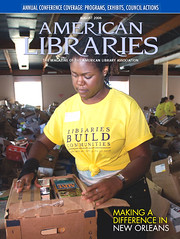
VOLUNTEER DAYS AT ALA ANNUAL CONFERENCE 2006.
Dubbed “the yellow swarm” because of their distinctive bee-colored “Libraries Build Communities”T-shirts, a volunteer workforce nearly 1,000 strong descended on New Orleans libraries for two days of hard labor, painting, fixing, sorting, and stacking at more than 20 locations all over the city.
Monday, August 07, 2006
Where Most Needed. A Librarian at the Kitchen Table. No. 393.
"Where Most Needed" is an interesting blog about the Charity Industry.
Recent entries of interest:
Hermitage Museum Responds with Surprising Transparency to Insider Thefts
Oxfam Report Decries In-Kind Food Aid, A Mainstay of US NGOs
Before and After Death, The Rich are Getting Stingier
Recent entries of interest:
Hermitage Museum Responds with Surprising Transparency to Insider Thefts
Oxfam Report Decries In-Kind Food Aid, A Mainstay of US NGOs
Before and After Death, The Rich are Getting Stingier
Sunday, August 06, 2006
Max Havelaar- A Book That Changed the World. A Librarian at the Kitchen Table. No. 392.

''I have suffered greatly''
Most people know the
Max Havelaar-Foundation which awards a quality label to products that have been produced according to principles of fair trade. Perhaps not so well known in the U.S. is the book, Max Havelaar: Or the Coffee Auctions of the Dutch Trading Company by Multatuli [Eduard Douwes Dekker]1860. Available as a Penguin Classic.
One of the most forceful indictments of colonialism ever written.
There is an article by PRAMOEDYA ANANTA TOER in the New York Times (April 18, 1999) in which he states:
The publication of ''Max Havelaar'' in 1859 was nothing less than earth-shaking. Just as ''Uncle Tom's Cabin'' gave ammunition to the American abolitionist movement, ''Max Havelaar'' became the weapon for a growing liberal movement in the Netherlands, which fought to bring about reform in Indonesia.
The Multatuli Museum is located in the birthplace of the author in Amsterdam.
Subscribe to:
Posts (Atom)


 Posts
Posts

