Thursday, December 30, 2010

Muncie Library Director Co-Chairs Muncie Action Plan

Virginia Niles demonstrates how librarians can work to build communities.
===========
The poverty rate and median household income are two of the many statistics about Delaware County that jump out of the American Community Survey released this week by the U.S. Census Bureau.

Virginia Niles, Mucie Public Library Director, is Co-Chair of the Muncie Action Plan.

Muncie isn't alone, Nilles says.

"I suspect most communities are seeing this happening, "she said. "Technology has changed everything. Industry is moving to the third world. But it's an exciting time. There are new opportunities. But we have to come together as a community as we have never come together before. If we all do this together, we will be successful. When we have disagreed in the past, we have stood still. We can't afford to do that any more.
"

Wednesday, December 01, 2010

From Read Ahead to Literacy Coalition: The Leadership Role of the Central New York Community Foundation in the Creation of a Local Institution

Community Literacy Journal

Spring 2011.

From Read Ahead to Literacy Coalition: The Leadership Role of the Central New York Community Foundation in the Creation of a Local Institution

Sunday, November 28, 2010

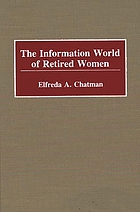
Elfreda A. Chatman


Fulton, Crystal. "An Ordinary Life in the Round: Elfreda Annmary Chatman." Libraries & the Cultural Record 45, no. 2 (2010): 238-59.
Elfreda Annmary Chatman was one of the preeminent library and information science scholars during the 1980s, 1990s, and early 2000s. The influence of her research on the work of other and through her students continues. Focusing her research and theory development on the information behavior of the ordinary people around her, Chatman highlighted the importance of studying everyday life contexts and helped shape the direction of research for many scholars to examine information in everyday life circumstances. Her middle-range theories were intended to enable information researchers to understand the information behavior of individual and group and to facilitate the development of policies and practices to help people experiencing everyday information problems.


Thompson, Kim M.. "Remembering Elfreda Chatman: A Champion of Theory Development in Library and Information Science Education." Journal of Education for Library and Information Science 50, no. 2 (Spring 2009): 119-26.

This article tracks the process of constructing theory within the field of Library and Information Science (LIS) through an examination of Elfreda A. Chatman's research. Chatman notes in her early publications that she did not enter the field with the intent to create theory, but as she applied established theories, she noted that there were certain aspects of the behavior she observed that were not accounted for in the theories she was analyzing. She turned her focus to the social barriers to information access and began to frame her work with concepts and propositions that explained what she observed. By examining Chatman's use of key theories from the social sciences, this article demonstrates the viability of the application and creation of social theory within the LIS discipline.


and more here.

Survival Needs and Social Inclusion: Technology Use Among the Homeless

"Survival Needs and Social Inclusion: Technology Use Among the Homeless."

Jahmeilah Roberson & Bonnie Nardi
Department of Informatics
University of California, Irvine
Digital technology use among the homeless is linked to collaborative practices ensuring survival and inclusion in social worlds beyond their immediate communities.

ABSTRACT
This research reports an ethnographic study of issues
surrounding digital technologies owned and used by
homeless people in Los Angeles County. We identify two
themes—survival and social inclusion—that reveal, in part,
how digital technologies enable social ties for collaboration
in the lives of the homeless.
Author Keywords
Homeless, digital technologies, social inclusion.
pdf is here.

Monday, October 18, 2010

Culture is back on the poverty research agenda

The topic has generated interest on Capitol Hill because so much of the research intersects with policy debates. Views of the cultural roots of poverty “play important roles in shaping how lawmakers choose to address poverty issues,” Representative Lynn Woolsey, Democrat of California, noted at the briefing.

This surge of academic research also comes as the percentage of Americans living in poverty hit a 15-year high: one in seven, or 44 million.

Thursday, September 30, 2010

Library services to immigrants: the debate in the library literature, 1900-1920. No. 619.

Worth reading.


Novotny, E. (2005). Library services to immigrants: the debate in the library literature, 1900-1920, and a Chicago case study. Reference and User Services Quarterly, 42, 342-52.

Monday, September 20, 2010

Education or Exploitation? For-profit schools and working-class students.No. 618.


Commentary from the Center for Working-Class Studies:

Education or Exploitation?

GAO study found clear patterns of deception and pressure in recruiting, and admissions counselors at several schools encouraged applicants to lie on their government financial aid forms.

Saturday, September 11, 2010

Income, Poverty, and Health Insurance Coverage in the United States: 2009. No. 617.

Income, Poverty, and Health Insurance Coverage in the United States: 2009.

The U.S. Census Bureau will hold an online news conference to announce the findings from its annual report: Income, Poverty, and Health Insurance Coverage in the United States: 2009. This report contains the official national findings from the Current Population Survey (CPS).

The Web conference will consist of a simultaneous audio conference and online presentation. There will be no physical event. Information on accessing the Web conference is provided below. Reporters will be able to ask questions via the audio conference once the presentation is complete. For information about setting up an interview with a subject matter expert, see below.
When:
Thursday, Sept. 16, 10 a.m. EDT
Note: Local data for income, poverty and health insurance coverage will be available Tuesday, Sept. 28, when the Census Bureau releases new socioeconomic, housing and demographic data from the 2009 American Community Survey.

Wednesday, September 08, 2010

“Hunger Action Month”. No. 616.

Hunger Action Month.

Hunger, Homelessness & Poverty Task Force

Social Responsibilities Round Table
of the American Library Association

Saturday, August 21, 2010

Job-Seeking Help at the Public Library. No. 615.

Job-Seeking Help at the Public Library.

Workforce resources include programs, services, and tools that libraries can use to assist the unemployed in their community. This section also includes information about statewide initiatives and partnerships that help local libraries provide these resources.


Monday, July 19, 2010

State of Metropolitan America: On the Front Lines of Demographic Transformation. .No. 614.

Brookings Institution. State of Metropolitan America: On the Front Lines of Demographic Transformation. Brookings Institution. 1775 Massachusetts Avenue NW, Washington, DC 20036.

Now, as the nation and its major metropolitan areas reach a series of critical demographic junctures, forging a constructive path forward to the “next society” is as much about helping communities manage the velocity of change as it is about responding to its specific character. Failure to maximize shared responses to the inevitable challenges of change, and to promote common ownership of the solutions, will only serve to sow the seeds of intergenerational and inter-racial, inter-ethnic conflict. The resulting polarization, already evident in our national politics, impedes adaptation and the timeless American struggle to form a more perfect union.
Understanding—from the ground up—who Americans are, and who they are becoming, is a critical step toward building those bridges before they become impassable divides. We hope that the State of Metropolitan America proves a useful platform from which to build that understanding.


In the 2101 Brookings Study, the State of Metropolitan America: On the Front Lines of Demographic Transformation the socio-economic context for library service can be characterized in the face of five new realities: 1) growth and outward expansion of metropolitan American; 2) population diversification; 3) aging of the population; 4) uneven higher educational attainment; and 5) income polarization.

Thursday, June 10, 2010

2010 Call for "Real Stories" of Communities. No. 613.


The Community Indicators Consortium (CIC), as part of a grant from the Alfred P. Sloan Foundation, is seeking proposals to write "Real Stories" of communities, organizations, and/or jurisdictions that have tried, successfully and not so successfully, to integrate community indicators and organizational performance measures.

The Real Stories project is intended to provide real life examples of the advantages and challenges to both community indicator and organizational performance measurement projects as a result of integrating or linking these two types of efforts. The published Real Stories, from 5-20 pages in length, will be used to advance the knowledge of community indicators-organizational performance measures integration and for training and other outreach material to community leaders as a way to improve or inform decision-making and create measurable, positive change in communities.

We are looking for proposals from individuals and groups who are directly involved in these efforts as well as individuals and organizations that work with community indicator and performance measurement projects. A stipend of $2,000 will be awarded for each Real Stories published.Three-to-five Real Stories will be selected for publication in 2010.

The deadline for submitting proposals for the 2010 Call for Real Stories is June 22, 2010. Notification of selected proposals and guidelines for development will be sent on July 15th. The deadline for the written first draft is September 15, 2010.

Visit the CIC web site for more information about the Real Stories project and the call for proposals. You can also download the Real Stories Proposal submittal form for more details, or contact the Project Steering committee at CIPM@communityindicators.net

Sincerely,

Allen Lomax and Cheryle Broom
Integrating Community Indicators and Performance Measures Co-Chairs

Monday, June 07, 2010

Hunger, Homelessness, and Poverty Task Force. No. 612.

"Free for All" by Kate Bowman-Johnston.

The public library as a place for transformation.
By Kate Bowman-Johnston.

[The article is accessible online but requires a free registration to the website. Lisa Gieskes, coordinator of the Hunger, Homelessness, and Poverty Task Force of SRRT, is quoted in this article.]

in Sojourners May 2010.

Friday, April 23, 2010

AIRS TAXONOMY .No. 611.

Welcome to the Taxonomy Web Site

This site is a support tool which allows licensed subscribers to search the AIRS/211 LA County Taxonomy in a variety of ways, print the Taxonomy in various formats, download the file that will allow them to incorporate the Taxonomy in their database initially and keep it updated over time as the Taxonomy changes and grows, view recent changes and additions, and develop, save and share customized versions of the Taxonomy through the Filters function.

Monday, April 05, 2010

Workforce Investment Act, Policy Brief- 2010. No. 610.

LOCAL PERSPECTIVES ON WIA REAUTHORIZATION. This 21-page Policy Brief reports on the February 18, 2010 CAAL Roundtable discussion of WIA and the Adult Education and Economic Growth Act with 19 leaders of local programs and institutions identified by their peers as providing exemplary "adult education for work" services within a particular community or local labor market. The programs are located in 16 states representing all regions of the U.S. This Brief contains important messages for state
policy makers as well as federal. [March 26, 2010]

In pdf here..

Wednesday, March 03, 2010

Street Lawyer: Legal Tools for Economic Justice. No. 609.


In our effort to build the movement to end and prevent homelessness, we have provided this community forum to advocates, attorneys, policy makers, service providers and homeless people. We invite you to join with us, make use of these materials, and contribute to our collective effort to eradicate homelessness and its causes.

Sunday, February 28, 2010

Researching Local Organizations: Simple Strategies for Building Social Capital. No. 608.

Drueke, Jeanetta. 2006. Researching Local Organizations: Simple Strategies for Building Social Capital. Reference and User Services Quarterly 45 (summer): 327-333.

ABSTRACT
The contribution of libraries to the development of social capital is a current focus of local libraries and library organizations. Using strategies and parameters developed for a project initiated by a humanities project, based at the University of Nebraska-Lincoln, this article provides a few simple strategies librarians can use to identify and research organizations of interest to local citizens and groups.

Monday, February 22, 2010

Healthy Food Financing Initiative. No. 607


Healthy Food Financing Initiative

Philadelphia — The Obama Administration today released details of an over $400 million Healthy Food Financing Initiative, which will bring grocery stores and other healthy food retailers to underserved urban and rural communities across America. TThe initiative is a partnership between the Departments of Treasury, Agriculture, and Health and Human Services.

The U.S. Food Environment Atlas

Food environment factors—such as store/restaurant proximity, food prices, food and nutrition assistance programs, and community characteristics—interact to influence food choices and diet quality. Research is beginning to document the complexity of these interactions, but more is needed to identify causal relationships and effective policy interventions.

Friday, January 22, 2010

Data for Democracy. No. 606.


The Data for Democracy Webinar Series is dedicated to helping our constituents – elected officials, labor leaders, members of the media, organizers and community groups – use NPP's data and tools more effectively. In general, webinars will last one hour, will be interactive and will include state and – when possible – even more localized data.

National Priorities Project (NPP) is a 501(c)(3) research organization that analyzes and clarifies federal data so that people can understand and influence how their tax dollars are spent.

Thursday, January 14, 2010

Call 2-1-1 for help with food, housing, employment, health care, counseling and more. No. 605.

2-1-1 provides free and confidential information and referral. Call 2-1-1 for help with food, housing, employment, health care, counseling and more. Learn more about your local 2-1-1 by looking it up here.