Saturday, March 31, 2007

LIBRARIANSHIP AND HUMAN RIGHTS: A 21st CENTURY GUIDE by Toni Samek. No.450.


LIBRARIANSHIP AND HUMAN RIGHTS: A 21st CENTURY GUIDE

Toni Samek

Foreword by Edgardo Civallero

Contributions by Kenneth D. Gariepy


This book is dedicated to the many courageous library and information workers throughout the world and through the generations who have taken personal and rofessional risk to push for social change.

Friday, March 30, 2007

National Coalition Against the Death Penalty Calls for Gonzales Resignation. No. 449.

NCADP calls for Gonzales' resignation:
With the recent revelations that differences regarding the death penalty played a role in the dismissal of at least three U.S. attorneys, our fears, sadly, have been justified.

Then, as now, Mr. Gonzales placed Bush?s political agenda above honesty, integrity , and commitment to fairness. In Texas this took the form of cursory review - and then denial in every single case but one - of clemency applications as President Bush parlayed his "tough-on-crime" persona into a successful run for the Republican presidential nomination.

Today, Mr. Gonzales' failed priorities have contributed to a politicized federal death penalty system instead of one based on fairness and integrity.


National Coalition Against the Death Penalty
Since its inception in 1976, NCADP has been the only fully staffed national organization exclusively devoted to abolishing capital punishment. NCADP provides information, advocates for public policy, and mobilizes and supports individuals and institutions that share our unconditional rejection of capital punishment.

Our commitment to abolition of the death penalty is rooted in several critical concerns. First and foremost, the death penalty devalues all human life - eliminating the possibility for transformation of spirit that is intrinsic to humanity. Secondly, the death penalty is fallible and irrevocable - over one hundred people have been released from death row on grounds of innocence in this "modern era" of capital punishment. Thirdly, the death penalty continues to be tainted with race and class bias. It is overwhelming a punishment reserved for the poor (95% of the over 3700 people under death sentence could not afford a private attorney) and for racial minorities (55% are people of color). Finally, the death penalty is a violation of our most fundamental human rights - indeed, the United States is the only western democracy that still uses the death penalty as a form of punishment.

Thursday, March 29, 2007

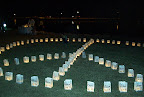
Luminaries: The Fifth Year of War in Iraq Begins. No. 448.


From Tom Baxter

I have been part of the antiwar team at the Capitol, Sundays 12:30-2:30;
Thursdays 4:00-6:00 for the last five years.

Involved in almost every antiwar event in Tallahassee since returning from Vietnam. Involved in the planning for the Luminary Memorial Forth Anniversary Memorial at Lake Ella.

Didn't support the inclusion of the names of soldiers who had their lives wasted in Iraq; didn't object.

Wasted, wasted because it took our President took four years before he consulted with others to develop a 'new' strategy. A 'new' strategy as opposed to 'staying the course' but still continues destruction of the Iraqi nation and people.

A failed strategy, that after turning Iraq into a battlefield, killing almost a million of Iraqis, turning millions upon millions into refugees, destroying Iraqi society, so the options open to children are begging or selling their bodies on the streets of Baghdad. A strategy that can not even make the road between the Green Zone and the Baghdad airport safe after four years, nor reduce the rate of acute childhood malnutrition to the obscene levels seen under Saddam. There has been one thing our
strategy has been able to do: protect the MEK, who murdered so many Kurds and Shias on Saddam's orders from the Kurds and Shia.


**************

Two requests at the memorial brought me almost to tears. One was a request from a couple who asked me to photograph a luminary for his parents. They looked at everyone and this was the only "Wyatt, Age 26." I complied.

Later a young man approached and wanted to make a luminary for a fellow Marine, PFC Chaires.

---Tom Baxter
Fiat justitia; ruat coelum
USAV 1967-69
http://tombaxter.livejournal.com
Tallahassee, Florida
Write on my gravestone: "Infidel, Traitor." --infidel to every church that compromises with wrong; traitor to every government that oppresses the people."--Wendell Phillips


=========
Letter from SU ECENIA at Tallahassee Democrat.


This coming Monday marks the beginning of the fifth year of the war in Iraq. And, while President Bush prepares to send more troops to Iraq and Congress continues to debate what it intends to do, the tragic loss of mothers and fathers, husbands and wives, sisters and brothers continues.

As of Wednesday, 3,192 Americans had sacrificed their lives in this unnecessary war, tens of thousands had been wounded, and an untold number of noncombatants had died.

Many people I know are torn. They oppose our continued involvement in Iraq, they want to do something, but they don't want to do anything that might imply any disrespect for the men and women making the sacrifices.

If you feel this way, join other Tallahasseeans from 7-9 p.m. Monday at Lake Ella for a luminaria walk. We will place more than 3,400 luminarias around the lake commemorating the coalition troops who have died in the conflict. "It's Time To Come Home" is both the name and message of the grass-roots group that has organized this event.

This is an event at which Tallahasseeans can honor the immense sacrifice of those who have died and, at the same time say: No more. It's time to come home.

Sunday, March 25, 2007

Industrial Areas Foundation. No. 447


Industrial Areas Foundation.
The IAF develops organizations that use power - organized people and organized money - in effective ways. The secret to the IAF's success lies in its commitment to identify, recruit, train, and develop leaders in every corner of every community where IAF works. The IAF is indeed a radical organization in this specific sense: it has a radical belief in the potential of the vast majority of people to grow and develop as leaders, to be full members of the body politic, to speak and act with others on their own behalf. And IAF does indeed use a radical tactic: the face-to-face, one-to-one individual meeting whose purpose is to initiate a public relationship and to re-knit the frayed social fabric.

Friday, March 23, 2007

Guardians of Language, Memory and Lifeways. No. 446.


The national conference, Guardians of Language, Memory and Lifeways: Tribal Archives, Libraries, and Museums, provides a network of support for tribal cultural institutions and programs. It is a unique event that brings together a wide variety of people that share the common goal of cultural preservation. The 2007 conference builds on two previous conferences that were held in Arizona during 2003 and 2005.

Monday, March 19, 2007

Too Much: Inequality & Excess. No. 445.

Too Much each week explores excess and inequality, in the United States and throughout the world. We cover a wide swatch of economic and political territory, everything from executive pay and lifestyles of the rich and famous to the latest research insights on how staggering income and wealth divides are impacting our health and our happiness.

Too Much began publication in 1995 as a print quarterly jointly published by the Council on International and Public Affairs in New York and the Boston-based United for a Fair Economy, then became an online weekly nine years later.

Too Much, ever since its inception, has been edited by labor journalist Sam Pizzigati, the author, most recently, of the award-winning Greed and and Good: Understanding and Overcoming the Inequality That Limits Our Lives.

Wednesday, March 14, 2007

Connect with Community Action. No. 444

Do you know the people who run your local/county Community Action Agency/Board?
Community Action Agencies (CAAs) are nonprofit private and public organizations established under the Economic Opportunity Act of 1964 to fight America's War on Poverty. Community Action Agencies help people to help themselves in achieving self-sufficiency. Today there are approximately 1,000 Community Action Agencies serving the poor in every state as well as Puerto Rico and the Trust Territories.

Community Action Agencies Across America

The service areas of Community Action Agencies (CAAs) cover 96 percent of the nation's counties.* The agencies are connected by a national network that includes the Community Action Partnership national association, regional associations, state associations, a national lobbying organization, and a national association of Community Service Block Grant administrators.

Click here for a listing of CAAs and state CAA associations.

Saturday, March 10, 2007

Center for Migration Studies Library and Archives. No. 443.

The Center for Migration Studies of New York (CMS)is a non-profit organization, founded in 1964. Its primary goal is to support and undertake research, and to provide a forum for debate on international migration.


The Center's specialized library is a strong component of CMS activities. It currently holds over 27,000 volumes and includes 150 periodicals, 3,700 journal article reprints, 750 dissertations, and 1,900 conference papers. It is one of the most comprehensive libraries worldwide on migration, refugees and ethnic groups.

CMS Archives houses 101 collections that are processed to the folder level and include detailed inventories. Among the collections are the papers/records of artists, theatre personalities, politicians, labor leaders, newspaper publishers, immigrant aid societies, and refugee resettlement agencies.

Thursday, March 08, 2007

2-1-1 Serves 65% of U.S. Use 2-1-1 SEARCH. No. 442.

Every hour of every day, someone in the United States needs essential services - from finding an after-school program to securing adequate care for a child or an aging parent. Faced with a dramatic increase in the number of agencies and help-lines, people often don't know where to turn. In many cases, people end up going without these necessary services because they do not know where to start. 2-1-1 helps people find and give help.

By February 2007, 2-1-1 will be serving approximately 196 million Americans – over 65% of the U.S. population; 212 active 2-1-1 systems covering all or part of 41 states (including 19 states with 100% coverage) plus Washington, DC and Puerto Rico. Canada has an additional 5 locations.

2-1-1 Search is a search engine that finds 2-1-1 call centers or other information and referral related sites in the United States. You'll see lists of providers with contact information and be able to view more detailed information about each location or program.

Monday, March 05, 2007

Selma-to-Montgomery March for Voting Rights. No. 441.


The Selma-to-Montgomery March for voting rights ended three weeks--and three events--that represented the political and emotional peak of the modern civil rights movement. On "Bloody Sunday," March 7, 1965, some 600 civil rights marchers headed east out of Selma on U.S. Route 80. They got only as far as the Edmund Pettus Bridge six blocks away, where state and local lawmen attacked them with billy clubs and tear gas and drove them back into Selma. Two days later on March 9, Martin Luther King, Jr., led a "symbolic" march to the bridge. Then civil rights leaders sought court protection for a third, full-scale march from Selma to the state capitol in Montgomery. Federal District Court Judge Frank M. Johnson, Jr., weighed the right of mobility against the right to march and ruled in favor of the demonstrators. "The law is clear that the right to petition one's government for the redress of grievances may be exercised in large groups...," said Judge Johnson, "and these rights may be exercised by marching, even along public highways." On Sunday, March 21, about 3,200 marchers set out for Montgomery, walking 12 miles a day and sleeping in fields. By the time they reached the capitol on Thursday, March 25, they were 25,000-strong. Less than five months after the last of the three marches, President Lyndon Johnson signed the Voting Rights Act of 1965--the best possible redress of grievances.

Selma-to-Montgomery National Voting Rights Trail.

Lyndon Baines Johnson Library

Voices of Civil Rights- Library of Congress.

Saturday, March 03, 2007

SenseofCommunity.com . No. 440.

SenseofCommunity.com is an international meeting place for people with a scientific or professional interest in the study or application of a sense of community.

A sense of community is one of those basic essential human experiences, a perception of one's connection with others, that we need for our well being. While many lament the loss of this sense of community, it is alive and well throughout the world. We are hoping to bring people together through this web site in order to better understand how to develop a sense of community and address its challenges so we can bring about healthy, socially just, and equitable societies.

Sponsored by:
Association for the Study and Development of Community (ASDC), a research and development organization for community capacity building and social problem solving. ASDC represents a network of leading community development practitioners and scientists in the United States and Europe, with offices in Gaithersburg, Maryland and Milan, Italy. ASDC combines the principled, rigorous use of scientific methods with practical tools to foster learning and improved capacity for social change.

SENSE OF COMMUNITY Library

Friday, March 02, 2007

Oxfam: Development in Practice. No. 439.

The journal, Development in Practice , is published by Oxfam. Development in Practice is an international journal offering practice-based analysis and research concerning the social dimensions of development and humanitarianism, and provides a worldwide forum for debate and the exchange of ideas among practitioners, academics, and policy shapers, including activists and NGOs. By challenging current assumptions, the journal seeks to stimulate new thinking and ways of working. Contributors represent a wide range of cultural and professional backgrounds and experience.
=
Volume 16, Number 6
"Which knowledge? Whose reality? An overview of knowledge used in the development sector." by Mike Powell.

An overview of issues relating to the use of knowledge by development organisations. It starts by exploring the various definitions of knowledge which exist in a world of many cultures and intellectual traditions and the role of language. It considers their relationship with each other and with the many and varied ‘informational developments’ – information-related changes in work, culture, organisations, and technology across the world. It argues that these issues pose a number of fundamental strategic challenges to the development sector. The second part looks at where, in practice, development organisations get their information and knowledge from and identifies problem areas with many of the channels used. Its conclusion is that most current practice consistently militates against the type of relationship and type of communication that are essential if development policy and practice is to be anything other than an imposition of external ideas, however well intentioned.